
Continuing on from last time
Short Term Goals
Goals can be either short term or long term. A good life plan has both.
Short term goals serve as enabling stepping stones that help to achieve long term goals.
These kinds of goals are “enabling” because they:
Move the plan closer to the final, long term goals. They are like preliminary steps along the way to realizing an outcome.
For example, securing a down payment would be an important short term goal for someone launching a plan to purchase a home.- Inspire the work – once a short term goal is realized, that success can help to inspire further efforts along the journey to final, long term goals.
For example, producing a new business product that is met with praise can inspire you to create another product which will create additional revenue for your business. - Help to keep efforts focused on the long term goals by serving as stepping stones across a stream of competing and distracting activities, occurrences and events.
For example, college course curricula are designed to keep students on track working toward their major. Each course completion is a short term goal leading up to receiving their diplomas.
A long term goal may become more realistic if you break it down into smaller parts, or a series of short term goals.
For instance, if you’re facing a large debt, you may be paralyzed by fear at the idea of paying off thousands of dollars. However, breaking it down into smaller monthly payments lets you see a light at the end of the tunnel with a final payoff date in the future.
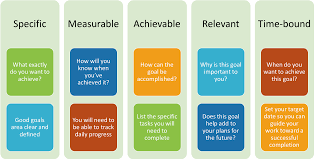
Short term goals help ensure that the S.M.A.R.T. principle of having measurable goals is being adhered to.
If long term goals are truly measurable, the degree of success of short term goals can help to determine the success of long term goals. Short term goals can help you make adjustments and realign your objectives along the way if you need to.
Think of these short term goals as your life’s to do list. The more small goals you can check off your list, the harder you’ll want to work to check off the rest of your list. Some goals may be fun, others may be tedious, but they will all lead to your ultimate long term goal of improving your life.
Long Term Goals
Long term goals tend to be the major goals of any plan and are, as the name suggests, set out into the future or for the long term.
It’s important to have long term goals because these are the goals that reflect the ultimate outcome you desire. Long term goals should articulate the purpose of your efforts and the motivation for your plan.
For that reason, they should follow the S.M.A.R.T. principles and be specific, measurable, attainable, realistic, and timely.
Some people have a difficult time making long term goals realistic and timely. Given that a long term goal is set to be realized way in the future, there can be tendency to make it lofty and unrealistic.
That’s why it’s important to put a significant amount of time into setting long term goals. Sometimes the process of setting short term goals can help to clarify long term goals and make them more realistic.
For example, earlier we used the process of achieving a down payment as a short term goal towards realizing the goal of purchasing a house.
If we stick with that analogy and change the facts so that the short term goal of saving for the down payment is not achieved by the specified date, that would change the long term goal of buying a house by a certain date.
So instead of implementing a plan to purchase a house in 6 months, that plan could become one to purchase a house in 1 year.
This example illustrates how important it is to have measurable goals. Without measurable goals, the whole initiative might have been dropped instead of adjusted!
When measurable indicators are used, you can look upon them as early warning signs to help keep you on target and give you room to make changes as necessary without abandoning your desired goal.
The same holds true for the analogy of earning a college degree. Sometimes there are setbacks in our short term goals, such as possibly failing a necessary college course, but one setback should not derail your dreams.
Rather than drop out of school because of one failed class, simply revisit why you failed or ask if there’s an alternative course you can take. If you don’t want to adjust the date of your graduation, consider retaking the class during a summer break or an extra class during the regular semester.
Experiencing setbacks in reaching our goals is inevitable because we’re human. But we have the knowledge and capability to adjust our timelines and continue on our path.
There’s no harm in changing the path you’re on, but there IS harm in quitting altogether!
Comments are closed